
Autonomous Illusion



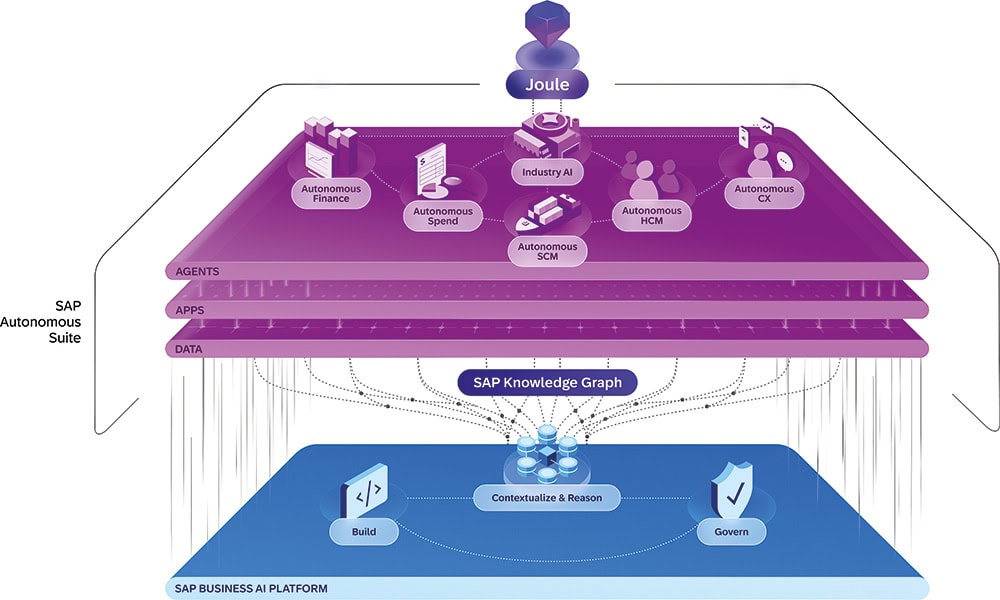
With the unveiling of the „Autonomous Enterprise“ at SAP Sapphire in Orlando, SAP has once again announced a major technological leap forward. The concept includes a unified AI platform for developing, contextualizing, and controlling agents; an autonomous application suite for core business processes; and new user interfaces designed to fundamentally transform how users interact with enterprise software.
As part of a partnership with Anthropic AI, SAP plans to leverage the Claude models in the future. These models complement the foundation models that already form the basis for Joule agents in human resources, procurement, and supply chain management. SAP CEO Christian Klein expects that the integration of the Business AI Platform with the SAP Autonomous Suite will lead to a deeper integration of AI agents into business processes, corporate data, and control mechanisms. The systems are designed to deliver precise, compliant, and secure results, unlock new revenue potential, and reduce costs at the same time. The reliable and efficient implementation of complex national and international regulatory requirements has always been one of the strengths of the Walldorf-based software company. This aspect is taking on added significance, particularly in Europe. The EU AI Act mandates that, for many AI applications, human oversight must be ensured and risks must be continuously monitored.
Anthropic AI: The Showstopper
Just a few weeks after the partnership was announced, Anthropic CEO Dario Amodei caused some consternation. He publicly called for an international, cross-vendor slowdown in AI development, citing the potential risks of powerful new models. Social and regulatory frameworks could hardly keep pace with the speed of technological progress: „We believe it is desirable for the world to have the option to slow down or temporarily suspend the development of state-of-the-art AI systems so that societal structures and research on the alignment of AI can keep pace with technological progress.“ Development cycles, which now often take place in just a few weeks, pose significant challenges for lawmakers and user companies worldwide.
What initially seemed like a pointed warning or a clever competitive move took on a new dimension when the U.S. government restricted access to certain advanced AI models for non-U.S. users. How this will be implemented for Anthropic’s employees remains to be seen. What is clear, however, is that this move marks the first time artificial intelligence has been treated not only as an economic factor but also as a strategic technology with implications for national security.
Imagine if the European Union or the German federal government had banned the use of S/4 Hana by companies outside Europe. It is precisely this kind of technological fragmentation that is now becoming a real possibility in the field of AI as well.
AI: The Genie Out of the Bottle
The reasoning is that, in the wrong hands, highly advanced models could expose security vulnerabilities on a previously unknown scale, attack critical infrastructure, or destabilize entire sectors of the economy—in other words, the genie can hardly be put back in the bottle. Whether these risks justify the measures taken is a matter of heated debate. What is undisputed, however, is that AI has thus definitively become a geopolitical factor. For Europe, this raises a key question: Will companies in the future be excluded from the latest developments and forced to rely on older or less powerful models compared to their competitors in the U.S.? Could the security arguments also mask a new form of technological protectionism that is increasingly shaping global competition?
AI Models as a Risk Factor
If Europe intends to consistently implement the self-imposed requirements of the AI Act, risk assessments in the future must take into account not only data storage but, to a greater extent, the AI models used and their long-term availability. This is because the concept of the Autonomous Enterprise is based on a central assumption: that the most powerful AI models will be available permanently and without restriction. For SAP customers, this development may seem far off at first glance. In fact, however, it touches on a core aspect of SAP’s long-term strategy. Until now, the key compliance question has been: Am I allowed to use this AI? In the future, another question could be added: Can I also use this AI on a permanent basis?
Autonomy versus Sovereignty
This is also where the discussion of digital sovereignty takes on greater significance. It is important to distinguish between autonomy and sovereignty. A key weakness of the concept of the Autonomous Enterprise lies in the term itself. While autonomous systems are certainly feasible in clearly defined technical environments—such as data centers or production facilities—implementing them in complex corporate structures proves to be significantly more difficult.
The term „Autonomous Enterprise“ therefore raises expectations that can only be met to a limited extent, both technically and organizationally. A more realistic concept is that of a highly automated enterprise in which AI systems support human decision-making rather than completely replacing it. „“Human in the Loop’ is increasingly becoming ‘Human above the Loop’: People no longer carry out every single step themselves, but rather monitor, evaluate, and control autonomous systems,” says Ulrich Faisst, CTO of the All for One Group. The real challenge, therefore, lies less in removing humans from the processes and more in redefining their role. In this context, digital sovereignty does not mean doing without automation, but rather the ability to maintain permanent control over the technologies, data, and AI models being used.
AI is not just a short-term fad; it’s here to stay. Caught in this tension, existing SAP customers must make investment decisions today while simultaneously laying the technical and organizational groundwork for implementing these new technologies. In doing so, two very different worlds of innovation are colliding.
SAP and AI—Two Worlds
On the one hand, there is the AI industry, where new models are released every few weeks and performance improvements occur at a pace never seen before. On the other is the SAP world, which is traditionally characterized by long-term stability and continuity—very much in line with Miele’s slogan, „Reliability for many years.“ This is precisely what existing SAP customers expect. The complexity of established SAP landscapes further complicates rapid technical and organizational adjustments. A look at the ongoing S/4 transformation illustrates this: SAP announced the end of Mainstream Maintenance for ECC 6.0 as early as 2020. Nevertheless, a significant portion of existing customers has not yet completed the migration. The introduction of new AI technologies will therefore inevitably encounter structures that can only be changed incrementally. Against this backdrop, it’s easy to scoff at the partnership between SAP and Anthropic or to dismiss the vision of the Autonomous Enterprise as just another marketing buzzword. It is not SAP that is jeopardizing the digital future of European companies here. Rather, clinging to outdated ERP and IT paradigms could cause companies to fall behind the next generation of technology. This is exactly what customers expect from a software vendor. If SAP were to opt for technologically inferior alternatives for ideological reasons, the criticism would likely be even louder.

Michael Englbrecht,
Member of the Executive Board,
Head of SAP,
Exxcellent Solutions

Dr. Ulrich Faisst,
CTO,
All for One Group

Dirk Ott,
Managing Director,
Milliarum
Multi-Model Strategies
The AI industry is increasingly moving toward so-called multi-model strategies. This involves using different language models depending on the use case and swapping them out as needed to reduce dependence on a single provider or model. Anyone who fails to diversify sufficiently in this area will face problems and is likely to find themselves unable to act—sooner rather than later. This applies to both SAP and its existing customers. The real danger for European companies, therefore, does not lie in the possibility that SAP might choose the wrong AI model. Rather, it lies in the fact that, out of concern for dependencies, Europe might once again miss the boat on a technological revolution.
ERP Romance and AI Reality
Added to this is an often romanticized view of the ERP world as it has been until now. The notion that companies today have complete control over their systems and processes hardly stands up to closer scrutiny. The reality is quite different: Many SAP landscapes are complex structures that have evolved over decades. Anyone who has been using SAP for decades also knows that this dependency did not arise solely because of AI. It results from the deep integration of business-critical processes into central enterprise systems. This reality existed long before cloud computing, BTP, or Joule. The question, therefore, is not whether dependencies exist, but what added value companies receive in return.
In the 21st century, autonomy does not mean technological isolation. Autonomy means the ability to use the best available technologies confidently and in a controlled manner. However, this is precisely where the term „Autonomous Enterprise“ becomes problematic. The term suggests expectations that supply chains, procurement, production, and human resources management will be managed largely autonomously in the future. This is reminiscent of earlier promises of digital transformation, such as the “Software-Defined Enterprise.” These, too, often proved to be significantly slower and more complex than originally predicted.
„Most companies don’t have an AI problem. Rather, they face the challenge of integrating new technological possibilities with their existing reality,“ says Michael Englbrecht, a member of the executive board and head of SAP at Exxcellent Solutions.
Vision or Illusion?
The future of the company likely lies not in fully autonomous operations, but in an intelligent division of labor between humans and machines. AI can create transparency, accelerate decision-making, and optimize processes. Responsibility for business decisions will remain with humans for the foreseeable future. The combination of process knowledge, corporate data, and an existing customer base provides SAP with a solid foundation. Whether this will actually lead to the „autonomous enterprise“ remains to be seen. Many of the announced features are still under development or have yet to prove their practical viability. Companies also face the challenge of improving data quality, harmonizing processes, and establishing governance structures—tasks that cannot be solved by new AI features alone. SAP’s vision is therefore neither pure marketing fiction nor a reality just yet. It marks a shift in direction, the success of which will only become apparent in the coming years through practical business implementation.



 Deutsch
  English
  Español
  Français